Prerequisite: A repeatable multi-timeframe process
On a small screen, scroll the figure sideways or open it full size.
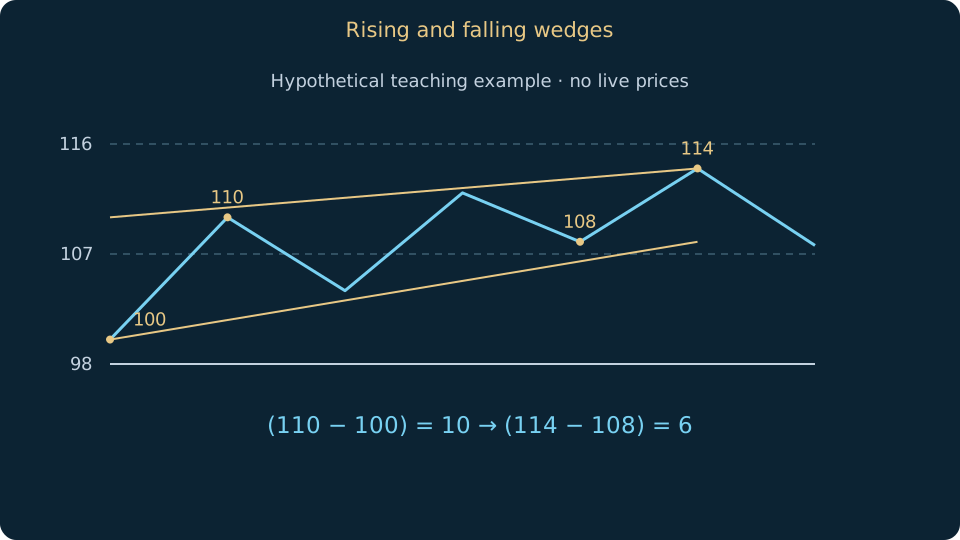
Read the figure
Both boundaries rise while their separation narrows. The final fall is a hypothetical break, not a probability estimate.
Learning objective
Distinguish a wedge from a parallel channel and test direction-specific hypotheses.
A wedge has two boundaries sloping in the same direction while converging. In a rising wedge, the lower boundary rises faster than the upper; a falling wedge has the opposite geometry. Parallel lines describe a channel, not a wedge. Compare slope and width objectively instead of naming every diagonal consolidation a wedge.
The rising-wedge bearish interpretation and falling-wedge bullish interpretation are common conventions, not certain outcomes. The previous trend determines whether analysts describe a potential reversal or continuation. Require a stated boundary-break rule and record opposite-direction breaks instead of excluding them from the sample.
Compression can leave a narrow apparent stop distance, but normal spread can consume much of it. Measure the current boundary values at the actual decision bar. A measured-height reference and a previous swing area are alternative ways to frame a scenario; neither removes the need to test execution assumptions.
Worked example
Illustration: lower boundary moves 100→108 while upper moves 110→114 over ten bars. Width shrinks 10→6 and both slopes rise, so the geometry is a rising wedge. A close below the current lower boundary meets a specified downward-break rule only.
Common mistakes
Do not force convergence by moving anchors after the break. A weak slope difference may be an ordinary channel within measurement error.
Practice
Construct a falling wedge with two falling boundaries and shrinking width. Write two possible break paths, then show a parallel channel using the same starting width.
Sources & further reading
Saved on this device. Export a backup before clearing browser data or changing device.
My learning pathEditorial review: 15 October 2026 · AI-assisted technical review; independent specialist review pending.
Translation available · editorial review pending