Prerequisite: A repeatable multi-timeframe process
On a small screen, scroll the figure sideways or open it full size.
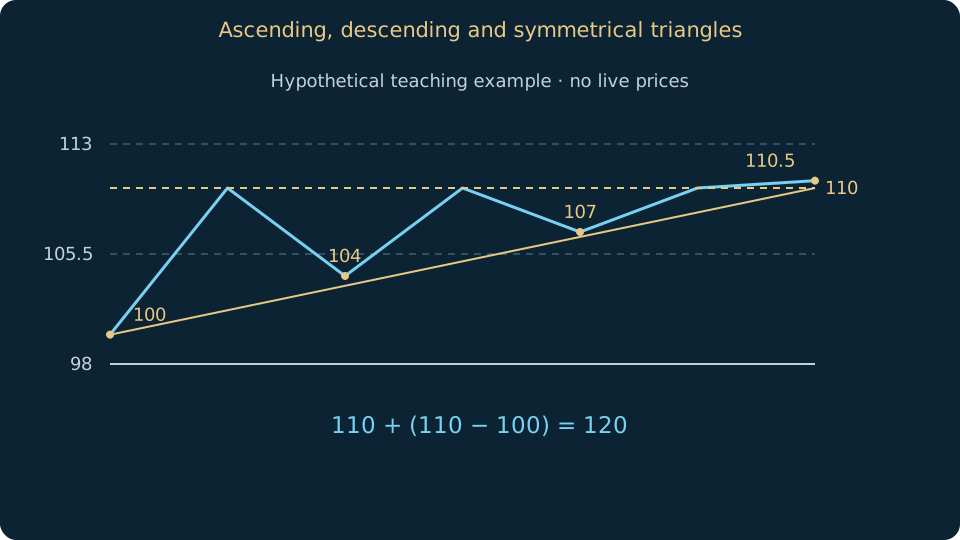
Read the figure
This ascending-triangle example has a flat upper boundary and rising lows. A downward break remains possible.
Learning objective
Classify converging boundaries without assuming a guaranteed breakout direction.
An ascending triangle has broadly horizontal highs and rising lows; a descending one has broadly horizontal lows and falling highs. A symmetrical triangle has falling highs and rising lows. All describe contracting geometry, but individual feeds and swing definitions can change which boundaries look most reasonable.
Contraction means the distance between boundaries shrinks with time. It does not reveal the next direction. Breakout studies require an explicit close, buffer or retest rule and a deadline for validity; after price drifts past the geometric apex, the original triangle interpretation becomes less useful.
A widest-height projection is a traditional scenario, not a promised destination. Measure the original vertical height and state the breakout reference. A very late or tiny break may leave little useful distance after spread. Include breakouts on both sides and immediate returns inside the triangle in your records.
Worked example
Illustration: flat top 110 with lows 100, 104 and 107 gives initial height 10. A close 110.5 qualifies under a close-above-110 rule; a conventional upward projection from 110 is 120. A later close below rising support can instead resolve downward.
Common mistakes
Do not equate ascending with guaranteed bullish resolution. Overfitting lines to exclude inconvenient candles changes the studied pattern.
Practice
Sketch all three triangle types with six swing points each. State both upward and downward break criteria and a time cutoff, then mark one false break.
Sources & further reading
Saved on this device. Export a backup before clearing browser data or changing device.
My learning pathEditorial review: 15 October 2026 · AI-assisted technical review; independent specialist review pending.
Translation available · editorial review pending