Prerequisite: A repeatable multi-timeframe process
On a small screen, scroll the figure sideways or open it full size.
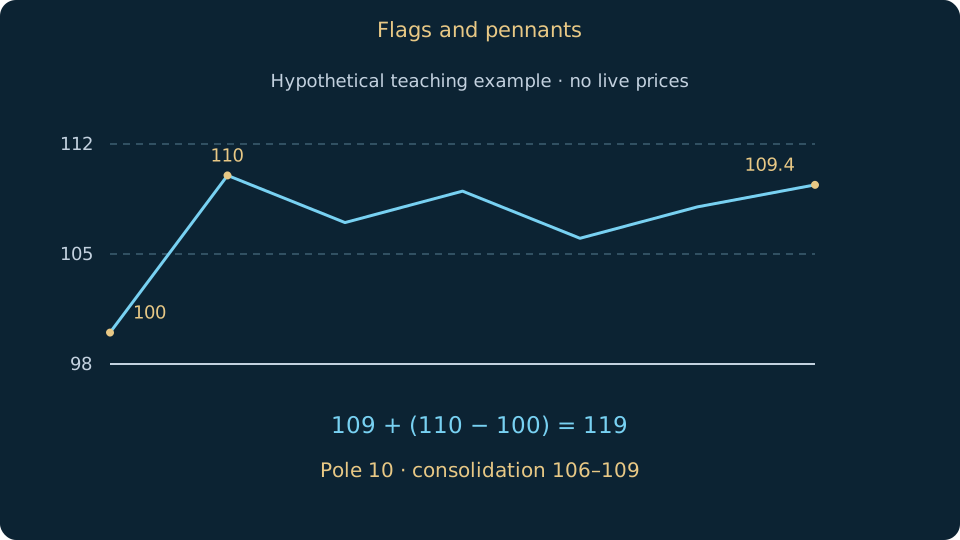
Read the figure
The drawing illustrates a flag after an impulse. Pole projection 119 is a reference, not a guaranteed outcome.
Learning objective
Distinguish a consolidation after an impulse from an arbitrary small range.
A flag is a short channel-like pause after a directional move, often sloping against that move. A pennant has converging boundaries after a similar impulse. The preceding impulse, sometimes called a pole, is part of the definition: without it, a small channel or triangle need not be a continuation candidate.
Specify maximum pause duration and depth relative to the pole. A deep, prolonged retracement may be better described as a range or a reversal attempt. The familiar continuation interpretation is a hypothesis; a break opposite the impulse remains possible and should be included in a systematic study.
Pole-length projection creates an illustrative reference after a defined break, not a guaranteed target. A sharp impulse can arise from news with wide spreads and poor execution. Before using any continuation rule, measure the risk distance from the planned entry and consider whether the relevant market is still orderly.
Worked example
Hypothetical pole 100→110 has length 10. A flag oscillates between 106 and 109; a close above its current boundary 109 may confirm your rule. Adding the pole length to 109 gives reference 119, with no claim that it will be reached.
Common mistakes
Do not select the pole start retrospectively to enlarge a target or call every countertrend channel a flag regardless of its duration.
Practice
Draw a bearish pole from 110 to 100 followed by a shallow upward flag. Define its boundaries, deadline, break rule and a failure above the flag high.
Sources & further reading
Saved on this device. Export a backup before clearing browser data or changing device.
My learning pathEditorial review: 15 October 2026 · AI-assisted technical review; independent specialist review pending.
Translation available · editorial review pending