Prerequisite: Leverage is exposure, margin is collateral
On a small screen, scroll the figure sideways or open it full size.
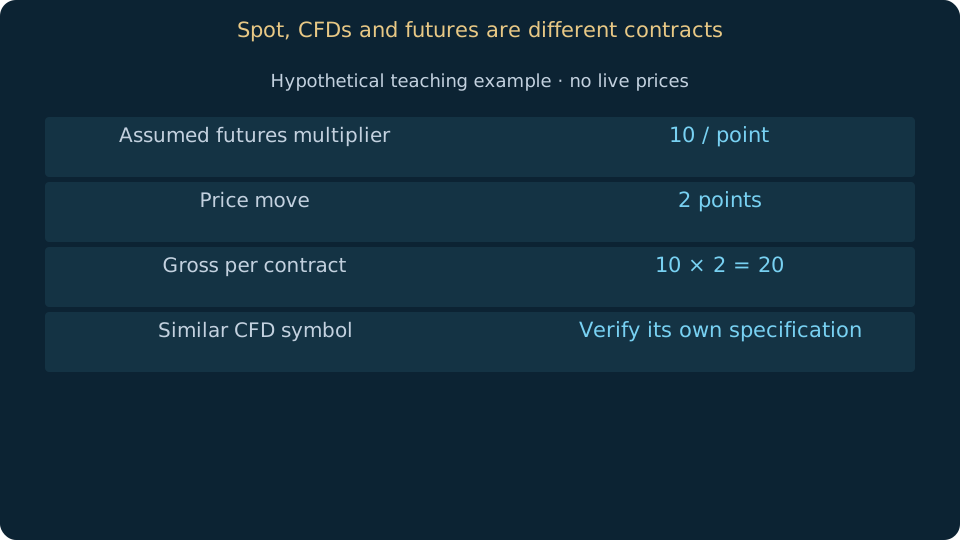
Read the figure
The multiplier converts points to money. Similar symbol names do not imply identical contracts or exposures.
Learning objective
Identify ownership, counterparty, financing and expiry before comparing products.
Spot describes a transaction with near-term settlement under the market’s convention; it does not by itself establish whether a retail account delivers the underlying currency or asset. Read the agreement. Some products marketed alongside spot prices are rolling derivatives rather than ownership transferred to you.
A CFD is generally an agreement to exchange a price difference with the provider, with contract-specific financing and margin. Exchange futures have standardised specifications and expiry, with clearing and margin processes. Clearing changes counterparty arrangements but does not eliminate market risk or all operational risks.
Futures prices can differ from spot because of financing, storage, distributions or other carry components. Holding beyond expiry may involve cash settlement or delivery according to the contract. Rolling to another expiry adds transaction costs and changes exposure; a continuous chart is not one directly tradable contract.
Worked example
Suppose a hypothetical futures contract has a multiplier of 10 account-currency units per point. A two-point move changes value by 20 per contract before costs. A similarly named CFD may use a different multiplier, so the same chart move need not mean the same cash result.
Common mistakes
Do not equate margin with maximum loss or compare spreads without adding financing, commissions and rollover costs.
Practice
Create a product comparison using actual official specifications: ownership, legal counterparty, multiplier, financing, expiry and settlement. Keep example prices hypothetical.
Sources & further reading
Saved on this device. Export a backup before clearing browser data or changing device.
My learning pathEditorial review: 15 October 2026 · AI-assisted technical review; independent specialist review pending.
Translation available · editorial review pending