Prerequisite: A repeatable multi-timeframe process
On a small screen, scroll the figure sideways or open it full size.
Read the figure
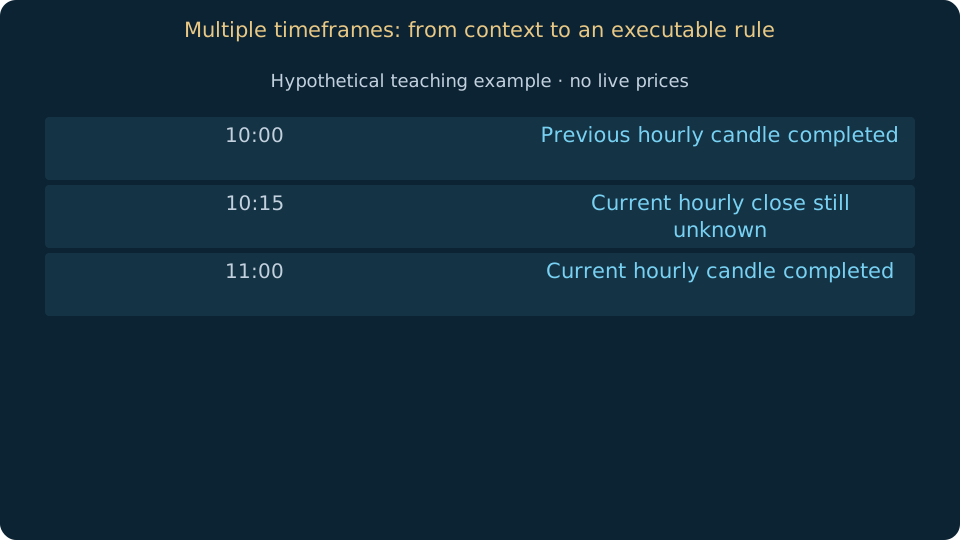
At 10:15 use information available then. The final close at 11:00 would introduce look-ahead bias.
Learning objective
Define what higher-timeframe information is available when a lower-timeframe decision is evaluated.
A workflow may use a higher timeframe for context and a lower timeframe for execution. This is an organisational choice, not independent evidence from two separate markets. Both views aggregate the same underlying price history, so agreement alone does not prove improved results.
The higher-timeframe candle may still be open when a lower-timeframe condition appears. Its high, low, close and indicator value can change. Specify whether the workflow uses only completed higher-timeframe candles or accepts changing intrabar values, and make historical and live behaviour comparable.
Translate a description such as daily trend plus hourly trigger into an exact sequence: context observation time, allowed direction, trigger, order type, invalidation, expiry and exposure check. Record a no-trade result when conditions conflict. Do not search progressively smaller charts until something supports an existing preference.
Worked example
Hypothetical hourly candle runs from 10:00 to 11:00. At 10:15 its close is not final. A five-minute test that uses the finished 11:00 close at 10:15 is using information unavailable then. The latest completed hourly close instead comes from 10:00.
Common mistakes
Avoid lookahead and counting correlated timeframe signals as independent confirmations. Higher-timeframe averages still lag, and a precise sequence can lose money despite perfectly aligned charts.
Practice
Write a two-timeframe practice rule using only closed candles. Annotate one lower-timeframe decision and identify the latest higher-timeframe candle allowed at that moment.
Sources & further reading
Saved on this device. Export a backup before clearing browser data or changing device.
My learning pathEditorial review: 15 October 2026 · AI-assisted technical review; independent specialist review pending.
Translation available · editorial review pending