Prerequisite: Backtesting without hindsight shortcuts
On a small screen, scroll the figure sideways or open it full size.
Read the figure
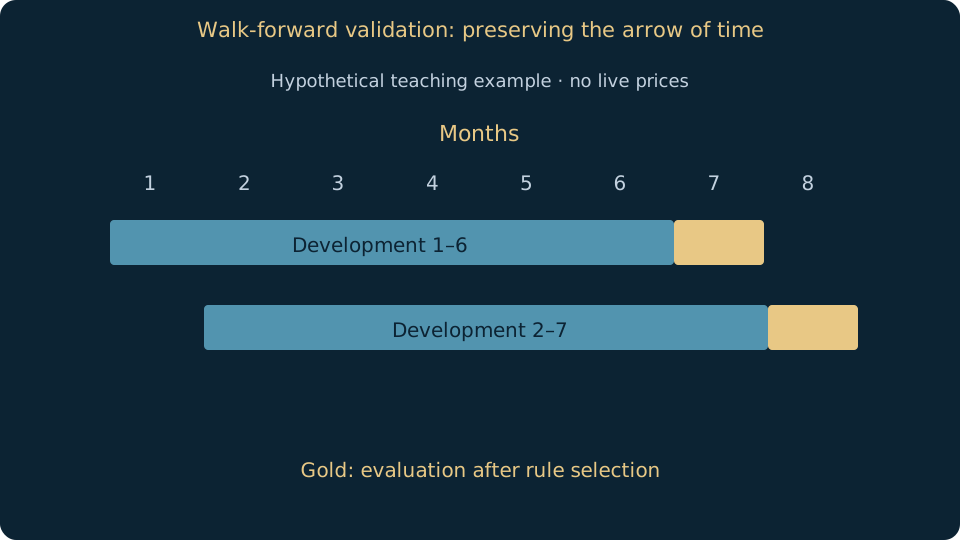
Month 7 evaluates rules selected using months 1–6. Month 8 cannot be used to choose the earlier rule.
Learning objective
Separate development from later evaluation and recognise the limits of repeated optimisation.
Walk-forward research repeatedly develops or selects a rule using one past window and evaluates the frozen rule on a subsequent window. The essential requirement is chronological information control. Prices, labels, parameter choices and event classifications from the evaluation window must not influence the preceding development decision.
Choose window lengths, update schedule and selection metric before comparing results. Each selected rule applies only to its next unseen segment. Combine the segment outcomes with consistent costs and capital treatment; do not retrospectively replace the weaker segments with whichever alternative later performed best.
Report sample size, turnover, drawdown, cost sensitivity and parameter stability rather than a single return number. Repeated experiments can contaminate supposedly unseen data. Preserve a final untouched holdout where feasible and label all simulations clearly. Good simulated results do not guarantee future execution or market behaviour.
Worked example
Hypothetically, use months 1–6 for development and month 7 for evaluation, then months 2–7 for development and month 8 for evaluation. Month 8 cannot help select the rule deployed for month 7. No gains are assumed in this example.
Common mistakes
Do not optimise on the entire timeline and call the same history out of sample. Avoid overlapping evaluation outcomes that count identical trades twice or hiding unsuccessful parameter searches.
Practice
Draw three chronological development/evaluation folds for invented monthly data. Mark when each parameter becomes fixed and list two ways future information could accidentally leak into development.
Sources & further reading
Saved on this device. Export a backup before clearing browser data or changing device.
My learning pathEditorial review: 15 October 2026 · AI-assisted technical review; independent specialist review pending.
Translation available · editorial review pending