Prerequisite: Currency correlations and relative exposure
On a small screen, scroll the figure sideways or open it full size.
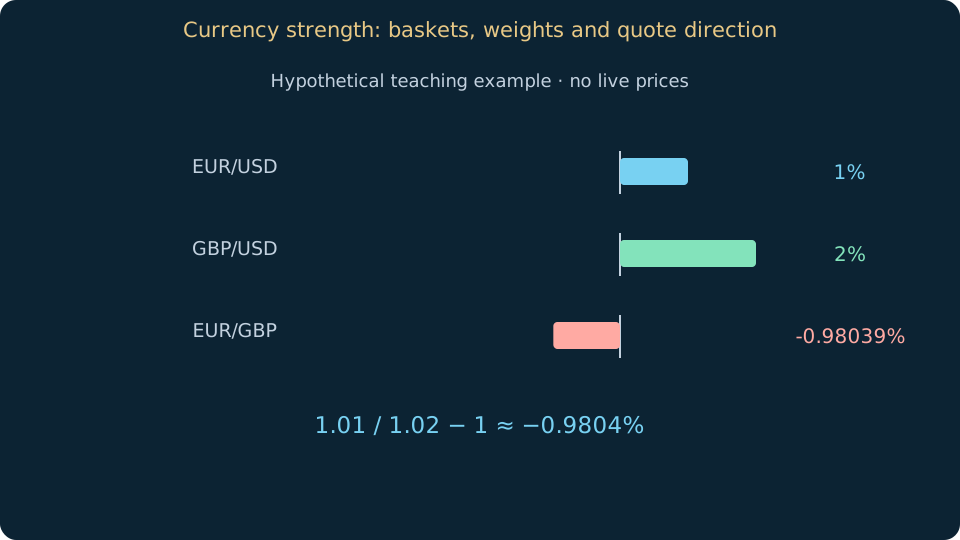
Read the figure
Both EUR and GBP rise against USD, but EUR falls against GBP because GBP rises proportionally more.
Learning objective
Define what a strength score measures before comparing currencies.
A currency is strong only relative to a stated reference. A score based on several pairs needs an explicit basket, weights, lookback and timestamp. An EUR/USD rise does not prove that EUR strengthened against every currency.
Quote direction must be consistent. For a USD basket, USD/JPY already expresses USD as base; EUR/USD must be inverted. A simple sign flip approximates small percentage moves, while inverse log returns change sign exactly.
Use aligned observations and disclose missing pairs. A daily reference-rate basket is not a live executable quote. Changes in basket membership can change a score even if the underlying price moves are unchanged.
Worked example
If EUR/USD rises 1% and GBP/USD rises 2%, EUR/GBP changes by 1.01/1.02−1≈−0.9804%. Both currencies can strengthen against USD while EUR weakens against GBP.
Common mistakes
Do not label an undefined score live or globally representative.
Practice
Choose a three-pair basket and document weights, quote inversions and the observation period.
Sources & further reading
Saved on this device. Export a backup before clearing browser data or changing device.
My learning pathEditorial review: 15 October 2026 · AI-assisted technical review; independent specialist review pending.
Translation available · editorial review pending