Prerequisite: A repeatable multi-timeframe process
On a small screen, scroll the figure sideways or open it full size.
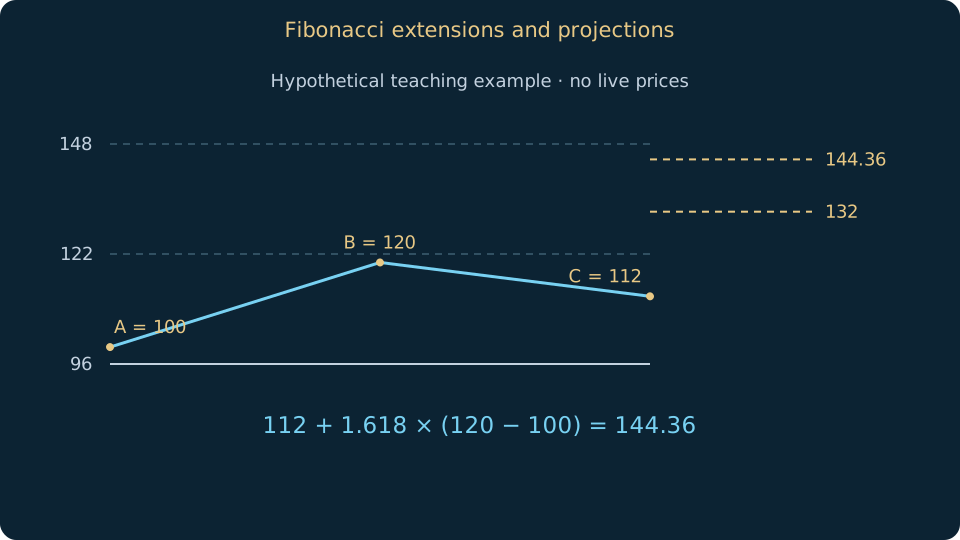
Read the figure
Three-point projection starts at C=112. A two-point tool gives a different 161.8% value, 132.36.
Learning objective
Use an explicit two-point or three-point convention for extension arithmetic.
Extensions describe reference prices beyond a selected move or projected from a later correction. Two-point tools and three-point trend-based tools can place different prices under similarly named percentages. Write the formula and all anchors rather than assuming that every platform uses the same convention.
For an upward three-point projection, A→B is the initial move and C is the correction anchor. A reference at multiplier k is C + k(B − A). A downward analogue subtracts the magnitude of the initial decline from C. The correction point must be known under the chosen swing rule before projection is claimed.
Ratios such as 1.0 and 1.618 are geometric scenario references. Price may stop early, overshoot or reverse, so combine the projection with known areas and a risk plan without assigning a success percentage. Multiple extensions from overlapping swings are highly related calculations, not independent forecasts.
Worked example
Illustration: A=100, B=120, C=112. The three-point 100% projection is 112+20=132; 161.8%=112+1.618×20=144.36. A two-point level based on A+1.618(B−A) is 132.36 instead, demonstrating why the convention matters.
Common mistakes
Do not compare extension screenshots without checking anchors and formula. Moving C retrospectively can convert a failed reference into a misleading apparent hit.
Practice
Use a downward move A=150, B=130 and correction C=138. Compute three-point 100% and 161.8% projections, then explain why changing C alters both while initial move size stays fixed.
Fibonacci workbench
Enter swing start A, swing end B and pullback C. C must lie between A and B. Retracements start at B; projections start at C. These are reference levels, not trade instructions.
Sources & further reading
Saved on this device. Export a backup before clearing browser data or changing device.
My learning pathEditorial review: 15 October 2026 · AI-assisted technical review; independent specialist review pending.
Translation available · editorial review pending